
Getting Cass County Court Records
Figure out what you actually need before you search. A case summary is one thing; the filed document, certified copy, or transcript is another. For a public Cass case summary, use Nebraska JUSTICE. The register of actions shows there too, along with any available images. Next, pin down which court holds the file: Cass County Court or Cass District Court. County Court keeps traffic, misdemeanor, ordinance, probate, juvenile, small-claims, and county-civil records. District Court maintains its own criminal, civil, domestic-relations, protection-order, and judgment files.
- Record the court, Cass County, case number, caption, and the document name or date needed. A targeted request works better than a broad name search.
- Check JUSTICE for the public case summary, register, and image/details link. Keep the exact case number if an image is absent.
- Call or visit the clerk holding the case. Cass County Court is in Room 201, and Cass District Court is in Room 303 at 346 Main Street in Plattsmouth.
- Use the CC 3:29 form for a specific filed document or certified copy, choosing electronic or mailed delivery and the requested certification.
- Use a courthouse public terminal when remote access is unavailable or clerk assistance is needed. The published sources do not identify the exact Cass terminal location, so call first.
- For a broader public-record request, use the appropriate Nebraska Public Records Act channel and describe the records, time period, and custodian precisely.
You can reach the clerk by mail, email, phone, or at the counter. Local pages make no promises about tracking numbers, turnaround, or a full list of counter payments. Ask the clerk about pickup, payment, ID, and delivery before you send anything.
Cass Court Clerk Record Split
Cass splits its court records between two offices. There is no single general county records desk. The County Court Clerk Magistrate keeps the county-court case files. The Clerk of the District Court holds the district case file, register, docket, judgment index, financial record, and service and filing entries. The administrative county clerk in Room 202 handles county-government work and keeps neither court docket.
Cass District Court Clerk
Room 303, 346 Main Street
Plattsmouth, NE 68048-1964
Always tell the clerk which court level you need. A felony case can start in County Court and then pick up a District Court record after bind-over. Name the wrong court, and your copy request goes to the wrong office, even with perfect party names.
Court Record Types
Not every record answers the same question. An online index tells you which case exists. The register shows what actions were entered. A filed document gives you the actual text of a pleading, order, or judgment. A certified copy authenticates that document for another court or agency. A transcript or county audio request is different again; it covers what happened in a proceeding, not the ordinary filed record.
- Index or case summary: court, case ID, caption, parties, case type, judge, and status.
- Register of Actions: chronological court events, action labels, dates, and possible image/details links.
- Filed documents: public pleadings, motions, orders, judgments, and available attachments.
- Certified copies: clerk-authenticated copies for a specifically identified case document.
- Transcript or audio: a separate proceeding record requested through the reporter, transcriber, or county-audio form.
- Historic files: older paper, microfilm, or archival material that may not have a remote image.
Start from the question you need answered. A register often explains the procedural history without every document. Need a court-stamped judgment? That takes a certified-copy request. An old case may call for a clerk or State Archives check rather than another online docket search.
Cass CC 3:29 Record Requests
The CC 3:29 copy-request form targets one case and one document. It asks for the court and county, case number, and caption. You also give the document's name and date, plus delivery contact details. Add your signature and your certification or delivery choice. It works better than a general docket request. The clerk sees exactly which piece of the file you want.
| Request Detail | Why It Matters |
|---|---|
| Court and Cass County | Routes the request to County Court or District Court, which keep different files. |
| Case number and caption | Identifies the right case and avoids a name-only mismatch. |
| Document name and date | Lets staff locate the actual order, filing, judgment, or register item requested. |
| Delivery and certification choice | Separates electronic or mailed copies from certified or non-certified copies. |
| Prepayment and contact details | Allows the clerk to process the selected form option and address questions about the request. |
Staff can search Cass County court records when you give them enough detail to pinpoint the case. They will then hand over an identified copy or a certified copy. What the policy does not do is make them certify that a wide-ranging search came up empty. So be specific. Narrow your request by court, by year, and by case type. Use the document's date whenever you can.
Inside a Cass County Court Record
A public Cass case record comes in layers. The summary identifies the case. The register of actions lists the court's entries in order. A public image can show one document, though that image layer may be incomplete. Read the visible register first. Then decide whether you need the full court file or a certified clerk copy, since they differ in detail and authentication.
| Case Number | The court, county, type, year, and sequence identifier. Use it exactly as displayed, such as the structure C13-TR-YY-######. |
|---|---|
| Case Summary | Case caption, court, parties, judge, type, opened date, and displayed status. |
| Register of Actions | The chronological record of filing, hearing, order, transfer, judgment, and other court events. |
| Orders and Judgments | Signed rulings or decisions. Read the public document when available, not only a short entry label. |
| Financial Record | Public costs, payments, balance, or restitution fields where available. These can change after later action. |
| Image or Details Link | A possible link to a public document, subject to digitization, privacy, sealing, and access limits. |
Some documents are public but never reach the remote image layer. The paper may be old, unconverted, restricted, or simply not uploaded. A public record label never permits rebuilding redacted personal details from other sources.
Cass Court Record Files
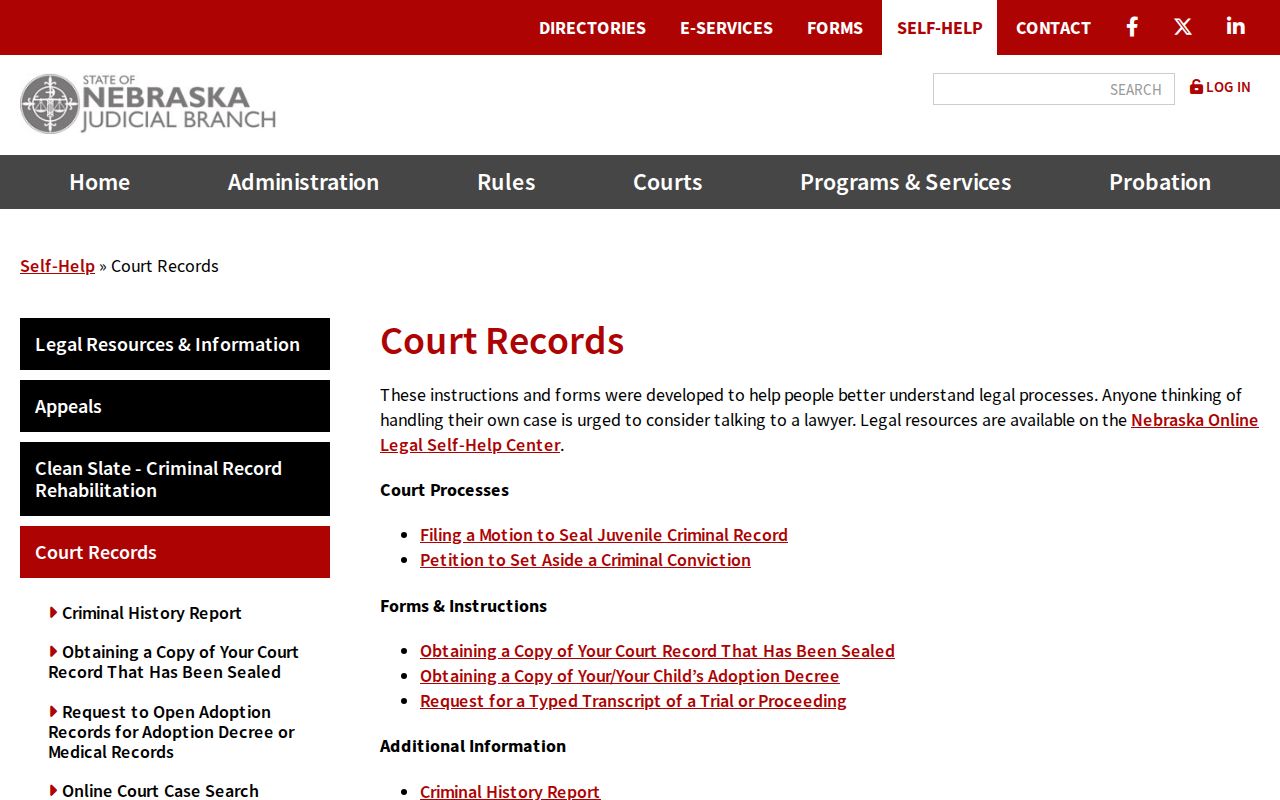
JUSTICE can show public images next to case detail. That image layer is not the whole Cass file, though. State materials treat April 16, 2008 as the boundary for document images. Older paper and restricted items may be missing. A missing image means check the register and the clerk, not assume the document never existed. Nebraska's court-records self-help page gathers the forms and routes for when a public online image falls short.
For old Cass files, ask who holds the paper or microfilm: the clerk, a retention custodian, or the State Archives. Cass records go back to the 1800s. Permanent retention does not make every page searchable or downloadable from home.
Fees and Certified Copies
A plain copy works for reference. A certified copy carries the clerk's authentication. A receiving court or agency may require it under seal. The CC 3:29 form lists delivery-specific copy charges. The Cass District Court page posts its own on-site fee context. Before paying, confirm the court and the document. Also confirm the delivery method, the page count, and whether certification is needed.
| Copy Option | Stated Amount | Source Context |
|---|---|---|
| Emailed non-certified copy | No charge | CC 3:29 electronic non-certified option. |
| Mailed non-certified copy | $0.25 per page | CC 3:29 mailed option. |
| Emailed certified copy | $1 per request | CC 3:29 electronic certified option. |
| Mailed certified copy | $1 per seal plus $0.25 per page | CC 3:29 mailed certified option. |
| District color or oversized photocopy | $0.50 per page | Cass District Court's published local on-site rate. |
District Court also lists $0.25 per black-and-white page, $1 per certification seal, and three seals for authentication. County-court fees beyond the documented form options are not posted. Check current amounts, prepayment, and delivery acceptance with the clerk before ordering.
Cass Court Record Transcript Route
A transcript is its own product, distinct from the papers filed in a case. The CC 1:14 transcript form asks for the court, the county, the case, the hearing, the judge, and the location. It also asks whether you want the full or partial proceeding and any exhibits. A reporter or transcriber gives you the estimate. Payment comes before preparation. No fixed Cass County transcript price or guaranteed turnaround exists. So plan for the quote to govern.
County court audio takes a different route: the digital-audio request form. The charge is $5 per requested hearing by email, with another $5 per storage device. You must sign privacy acknowledgments first. Remember that audio is not the official court record. An appeal carries its own bill-of-exceptions or transcript process.
Sealed Records and Public Access
Nebraska leans toward open court records. Most Cass County docket material can be inspected by the public. Still, sealed cases, juvenile files, adoptions, presentence reports, and protected financial information may be withheld, redacted, or limited in what you can see.
A docket search that comes up empty does not mean much by itself. The gap could reflect a seal, the case type, a privacy rule, the wrong court, an entry lag, or a paper record that was never converted. It does not prove a court record never existed.
Key Rules:
Nebraska Court Rule §1-805 permits public electronic access to specified court information, subject to access restrictions.
Nebraska Revised Statute §84-712 provides the public-record inspection and request framework, including response or estimate rules.
Nebraska Court Rule §2-215 states that filings are public unless law, rule, or court order restricts them.
Nebraska Revised Statute §43-2,108.05 gives sealed juvenile records restricted treatment.
An adult sealed record has its own authorized sealing or release process through the court. Use that route. A general copy request will not bypass a restriction. Do not submit a sealed-record request on someone else's behalf.
Cass Court Record Access Route
The most dependable order for a Cass County court record search runs like this: case number first, then the public register, then the specific document. Finally comes the right clerk or specialized form. A terminal at the courthouse allows public electronic inspection when remote access to the docket is not practical. A written Nebraska Public Records Act request can work for records in the proper custodian's control. But the court's case-specific search policy still demands enough detail to identify the case or document you want.
A historic paper file takes a few extra questions. Ask whether the record still sits with the Cass clerk. Ask whether it has been converted, or has moved to an archives or retention custodian. A certified copy means requesting both the court document and the certification, stated explicitly. A sealed or juvenile case requires the lawful access route. Each path respects the line between a public reference record and an authenticated or restricted court file.
Note: Keep the clerk's response, receipt, seal information, and complete case number together. Keep them with any Cass court record you obtain.